A Home Safety Checklist for Ageing Parents, Wherever You Live
There's usually a specific moment that starts this. A near-fall in the bathroom your mother mentions almost in passing. A hallway you suddenly notice is too dark when you visit in the evening. And then the harder part isn't the home modifications — it's figuring out how to raise it at all without your parent hearing "you're getting old and can't manage."
If you've tried already and got "I can do this myself" or "I don't want to spend the money," you're not doing anything wrong. That's close to the most common response caregivers report getting, wherever they're asking from — and it's rarely really about the money or the task. It's about not wanting to admit the thing that's prompting the offer in the first place.
Why this is worth doing before the crisis, not after
The research on this looks remarkably similar no matter where you're reading from.
In India, public health research on falls among older adults has found the rate varies widely by study — anywhere from roughly one in seven to over half of older adults surveyed, depending on the population — but the contributing factors show up again and again: poor lighting, cluttered walkways, unsafe bathroom flooring. A 2025 survey of older adults in urban Pune found awareness of these risks is often high, but actually acting on it — fixing the lighting, adding a grab bar — lags well behind. Worth noting too: with many Indian families already living multigenerationally, this conversation often looks less like a formal sit-down and more like a change one person quietly makes and the household adjusts to.
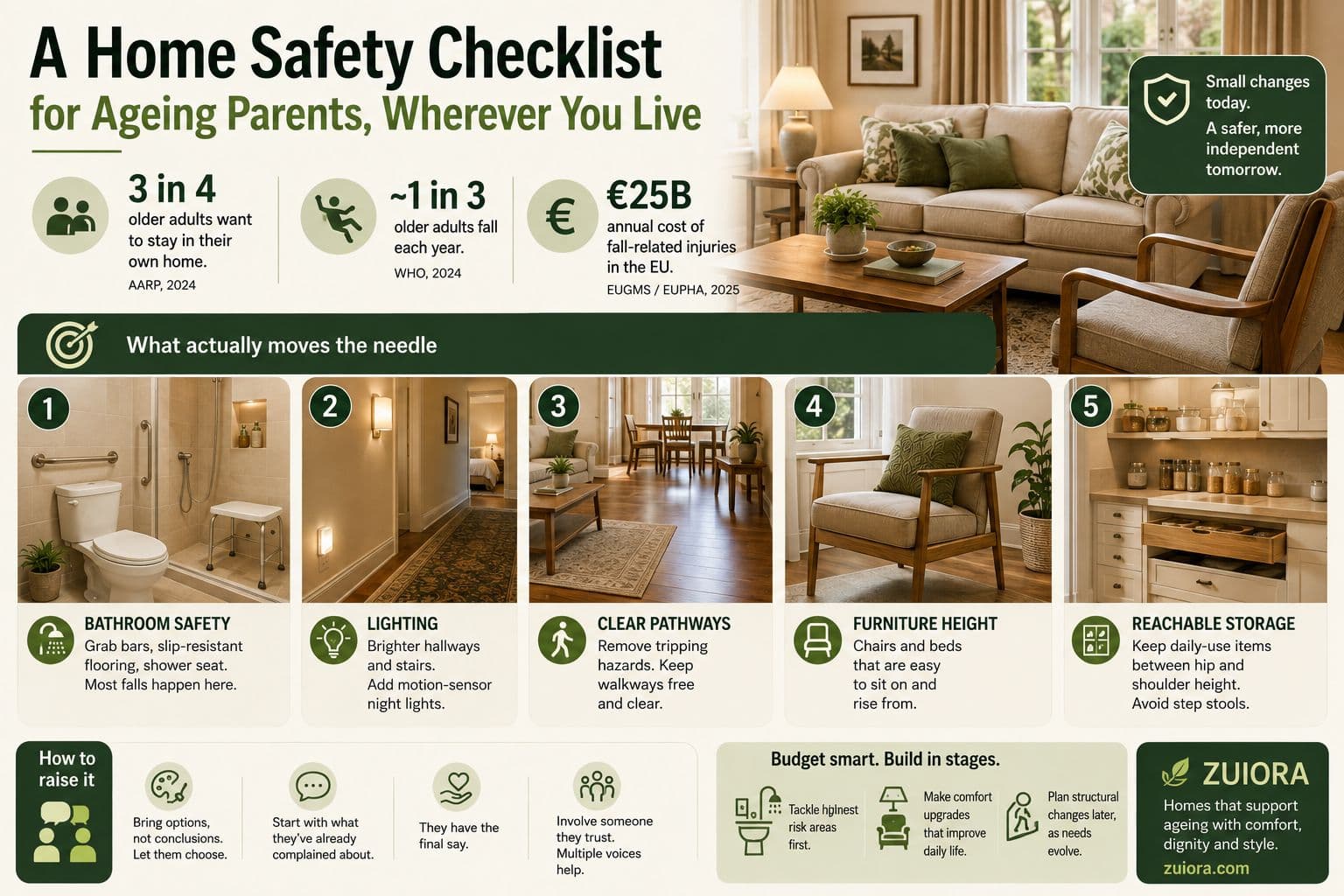
In the EU, a 2025 review of European research found an average fall prevalence of around 31% among older adults living independently at home, and the EU's own public health bodies estimate the annual cost of treating fall-related injuries at roughly €25 billion a year. Several EU countries, the UK and Ireland among them, already treat this as a policy issue rather than a private one: local authorities and health services often fund an occupational therapist's home assessment, and in the UK a Disabled Facilities Grant can help cover the cost of "home adaptations" — grab rails, ramps, walk-in showers — for those who qualify.
In the US, WHO data puts the annual fall rate for adults over 65 at roughly 28 to 35 percent, climbing to around 42 percent from age 70, closely matching the European figures above. And this isn't a niche concern for the audience most likely to be reading this: Sotheby's agents report that roughly four in ten of their affluent clients now name ageing in place as a leading priority when choosing where to live — which tells you this is being planned for proactively by people with means, not treated as a crisis-only decision.
What actually moves the needle
Skip the exhaustive checklist. In rough order of impact:
- Bathroom safety — a grab bar (or grab rail) near the toilet and shower, slip-resistant flooring, a shower seat if standing has become tiring. Most in-home falls happen here.
- Lighting — brighter fixtures in hallways and stairwells, plus a cheap motion-sensor night light on the path from bedroom to bathroom.
- Clear pathways — loose rugs, trailing cables, and low furniture in walking routes are responsible for a disproportionate share of trips, and cost nothing to fix.
- Furniture height — chairs and beds that don't require real effort to get up from.
- Reachable storage — moving daily-use items to between hip and shoulder height cuts down on step-stool trips.
None of this needs to happen at once. Bathroom and lighting first; everything else phased in over time, both for the budget and so it doesn't feel like an overhaul.
How to actually raise it
A senior living specialist's advice on this is worth repeating almost exactly:
Talk to them while they're still thriving and in control, not after something's already happened — it lets the conversation stay hypothetical instead of urgent.
A few other things that consistently help, wherever you are:
- Let them lead the decisions. Bring options, not conclusions. Your parent choosing the grab bar finish and the flooring tone changes who the project feels like it belongs to.
- Start with what they've already complained about. If the shower floor or the dark hallway has come up before, start there — it's proof this is about their actual daily friction, not a generic idea of what "elderly people need."
- Remember they have the final say. Even when you disagree with the pace, it isn't your decision alone to make — and treating it that way is usually what triggers the resistance in the first place.
- Involve someone else they trust. A sibling, a close friend, a doctor mentioning it separately — parents are often more likely to take a concern seriously once they've heard it from more than one person.
Budgeting for it without overbuilding
A reasonable sequence, wherever you're starting from:
- Address the highest-risk areas first — bathroom, main hallway, entry steps.
- Make changes that improve daily comfort even without the safety angle — better lighting, a more comfortable chair — since these get less resistance and more genuine enjoyment.
- Treat anything structural (ramps, stairlifts, layout changes) as a later phase, driven by how your parent's mobility actually changes rather than a worst-case assumption made now. In the UK, check whether a Disabled Facilities Grant or local occupational therapy assessment applies before paying for this privately.
You don't have to figure this out alone
Most of the friction in these projects isn't the construction — it's not knowing what's actually necessary versus what's being sold to you, and not knowing how to raise it without it landing badly. Working with people who design specifically around ageing in place, rather than a generic contractor, tends to produce homes that are safer without looking or feeling like it.
Zuiora works with families to design homes that support ageing parents without compromising on comfort or dignity — evidence-based, personalised, and phased to fit real budgets and real conversations, wherever you're based. Visit zuiora.com if you'd like a second opinion on where to start.
Sources
- AARP, 2024 Home and Community Preferences Survey
- "Awareness and Practice of Home Modifications for Fall Prevention among the Elderly Population in Urban Pune" — PMC / Indian Journal of Public Health, 2025
- Rommers et al., "Epidemiology of falls in community-dwelling older adults in Europe," Age and Ageing, 2025
- European Union Geriatric Medicine Society (EUGMS) / EUPHA, factsheet on falls among older adults in the EU-28
- UK Government guidance on Disabled Facilities Grants and home adaptations
- WHO fall-prevalence data, as cited in nurse-led home-based fall prevention programme research (ClinicalTrials.gov, NCT06643169)
- Sotheby's International Realty client survey, via Yahoo Finance
- A Place for Mom, via AOL/MediaFeed, "How to Deal With Elderly Parents Who Refuse Help"