The Scratchy Throat That Keeps Coming Back
You wake up with that familiar scratchy feeling in your throat again. It is not dramatic enough to keep you in bed, but it is there — making every swallow a little uncomfortable and your voice slightly off. By midday it has settled in properly. You have had this before. The hot soup or herbal drink you had yesterday brought some relief for a few hours, but today the same symptoms are back. The nasal block returns, and every now and then there is that light wheezing when you breathe. You try to ignore it and push through the day, but it lingers.
A Growing Global Problem
For many families around the world, sore throats and breathing troubles have become part of daily life. The World Health Organization estimates that respiratory illnesses linked to poor air quality affect hundreds of millions of people globally each year. In urban centres from Mumbai and Delhi to Beijing, London, and Los Angeles, frequent episodes of sore throat, nasal blockage, and wheezing are reported at rising rates. These symptoms are not isolated inconveniences. They are early signals of a larger problem with the air we breathe every day.
Why Children Are Especially Vulnerable
For adults, the constant exposure can lead to chronic irritation of the respiratory tract, increased inflammation, and higher risk of conditions such as bronchitis or aggravated asthma. But the impact is even more concerning when it comes to children. Their bodies are in sensitive developmental stages, with lungs and immune systems still maturing. Medical research shows that prolonged exposure to polluted air during childhood can cause lasting damage to lung function, reduced lung capacity, and impaired respiratory development. Studies have linked early-life exposure to fine particulate matter and indoor pollutants with a significantly higher risk of asthma, chronic obstructive pulmonary disease in adulthood, and in some cases, increased chances of lung cancer and other serious respiratory illnesses later in life. The developmental window makes children particularly vulnerable — what seems like a simple sore throat today can contribute to reduced lung growth and long-term health complications that may not become fully apparent until adulthood. Many also experience shortness of breath, difficulty breathing, chest tightness, and persistent cough as the irritation builds over time.
Why Temporary Remedies Fall Short
The usual remedies give short-term comfort. A bowl of hot soup feels soothing for a while. Ginger tea or steam inhalation might ease the discomfort for an hour or two. But the relief does not last. The next day or the day after, the scratchiness returns. The nasal block comes back. The wheezing and breathlessness show up when the air feels heavy. It is frustrating because you are doing the “right things” with food and home remedies, yet the problem keeps repeating.
Stories People Share
Many parents share similar experiences. One person on X described dealing with their child’s persistent sore throat and wheezing after bad air days, saying the symptoms would ease with soup but return quickly. Another wrote about their little one struggling with nasal block and headache after exposure to traffic and indoor air, trying different remedies without lasting success. These stories show how common the cycle is and how concerning it feels when nothing seems to fix it for good.
What Enters the Body Every Day
It all boils down to what enters the nasal tracts and lungs every day. The Air Quality Index, or AQI, is a measure used worldwide to show how polluted the air is on a given day. Higher AQI numbers mean more harmful pollutants are present. The main contributors are fine particulate matter (PM2.5 and PM10), nitrogen dioxide from vehicle exhaust, sulfur dioxide from industrial processes, carbon monoxide, and ground-level ozone formed by chemical reactions in sunlight. The health effects of PM2.5 are particularly well documented. In cities around the world, heavy traffic, construction dust, and industrial emissions push these levels up almost daily. Research from the World Health Organization shows that long-term exposure to high AQI is linked to increased respiratory problems and other health issues. The organization estimates that air pollution causes around 7 million premature deaths globally each year, with a large portion linked to respiratory and cardiovascular diseases. In children, chronic exposure to polluted air can reduce lung growth and function by up to 20 percent in some high-pollution areas. Adults living with consistently high AQI levels face higher risks of chronic bronchitis, asthma exacerbations, and in severe cases, lung cancer and other respiratory diseases.
When Indoor Air Becomes Worse Than Outdoor Air
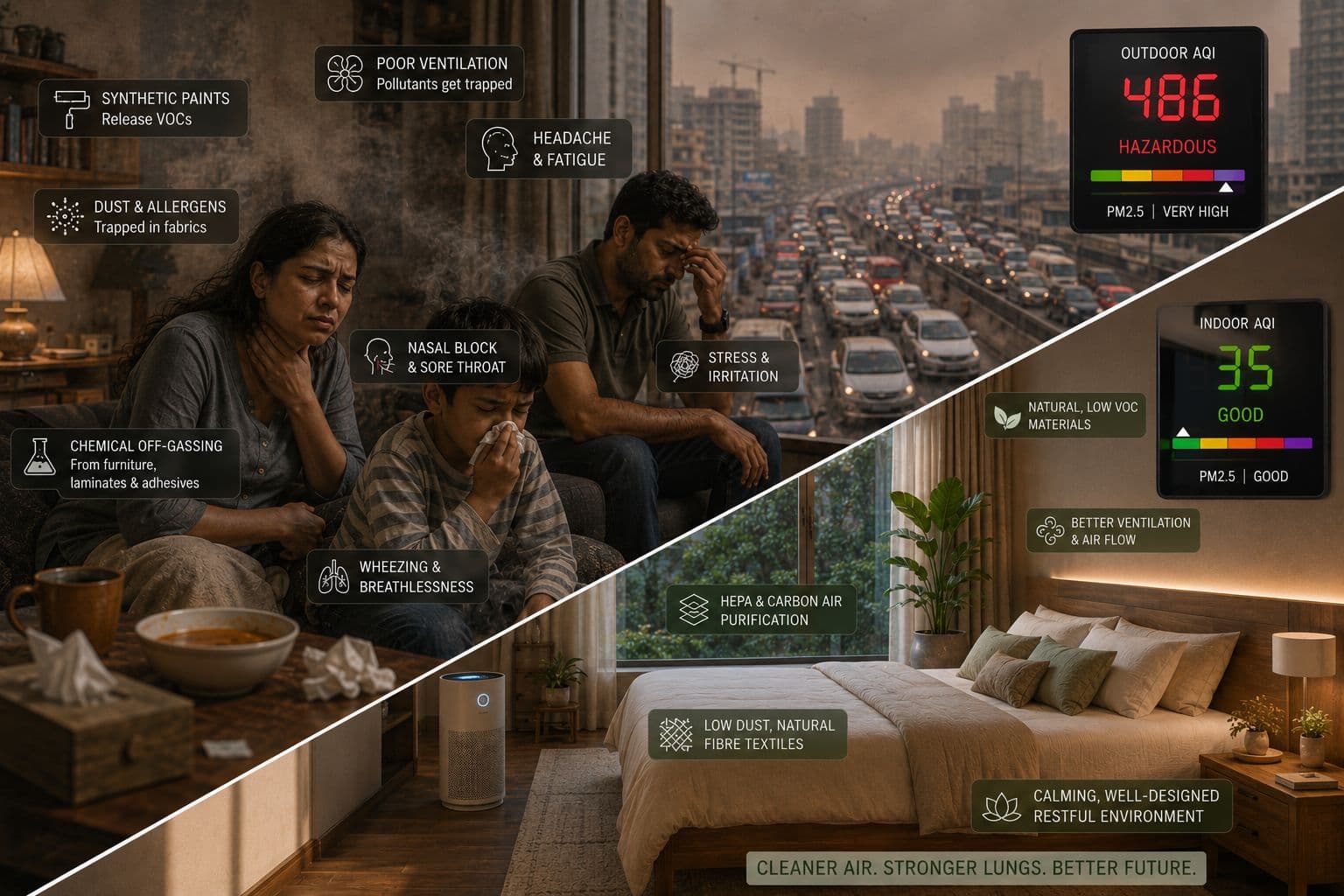
Indoor air quality can often be even worse than the air outside because pollutants get trapped inside. Research shows that indoor air pollution can be two to five times higher than outdoor levels in many urban homes, according to the United States Environmental Protection Agency. In some cases, concentrations of certain VOCs and formaldehyde can be up to ten times higher indoors than outdoors. Studies have linked poor indoor air quality to increased rates of respiratory symptoms, headaches, and long-term health risks, with children and elderly family members being particularly affected due to more time spent indoors. Many everyday materials we use in our homes add to the problem. Synthetic paints and varnishes release volatile organic compounds (VOCs) that linger for months or years. Laminate flooring and vinyl materials off-gas chemicals over time. Upholstery and carpets made with synthetic fibres trap dust and allergens. Even some premium furniture and cabinet materials contain formaldehyde and other irritants. In closed apartments and houses with limited fresh air, these keep the indoor environment heavy and irritating for little lungs.
What Research Tells Us About Solutions
Research in the field of architectural and environmental psychology has found practical solutions for improving indoor air quality and reducing sensitivity to airborne pollutants. Studies show that if you face these challenges frequently, it often means you are slightly more sensitive to your environment than others. Research on volatile organic compounds in indoor spaces suggests that improvements in the bedroom, such as replacing materials that off-gas chemicals, can help reduce sensitivity to pollutants that enter through the nasal passages. People who create spaces with lower chemical emissions often report feeling more resilient during the day, even when they are exposed to polluted air in busy offices or commutes.
Practical Changes That Make a Difference
Simple material replacements can make a big difference for breathing. Switching from synthetic paints to low-VOC or natural mineral-based options reduces chemical off-gassing. Replacing vinyl or laminate flooring with solid wood, bamboo, or natural stone helps cut down on trapped dust and emissions. Using natural fibre upholstery and rugs instead of synthetic ones lowers allergen buildup. These swaps, combined with mechanical solutions like high-efficiency particulate air (HEPA) filters in air purifiers or HVAC systems, and natural options such as activated carbon filters or indoor plants that absorb certain pollutants, can significantly lower indoor AQI. Electrical air purifiers with multiple stages (pre-filter, HEPA, and carbon) are particularly effective for capturing fine particles and VOCs.
How Zuiora and Lucy Can Help
Zuiora is built on the understanding that our homes should actively support health and well-being, especially in cities where air quality is a daily challenge. The platform approaches interior design as a practical tool for everyday wellness rather than a one-time aesthetic project. It focuses on evidence-based choices that improve how people feel in their spaces over the long term, whether they are planning a full renovation or simply looking for small, meaningful adjustments. Lucy, the AI design assistant at the heart of Zuiora, has been trained on research about indoor pollutants, material emissions, and how different environments affect breathing. She identifies the specific sources of high indoor pollution in your home by examining materials, ventilation patterns, and layout. She then provides practical solutions that respect your individual constraints, budget, and requirements, so the changes feel realistic and sustainable for anyone seeking a healthier living environment. With these adjustments, many people find they breathe easier, experience fewer sore throats, and wake up feeling fresh and ready for the day.
If frequent sore throats and breathing discomfort have become part of your routine, Lucy is here to help you understand the root causes in your space and find lasting solutions.
References
World Health Organization. (2022). WHO global air quality guidelines. https://www.who.int/publications/i/item/9789240034228
United States Environmental Protection Agency. (2023). Indoor Air Quality. https://www.epa.gov/indoor-air-quality-iaq
Weschler, C.J. (2009). Changes in indoor pollutants since the 1950s. Atmospheric Environment, 43(1), 153-169. https://www.sciencedirect.com/science/article/abs/pii/S1352231008009205
Salthammer, T. (2013). Formaldehyde in the indoor environment. Chemical Reviews, 113(4), 2145-2176. https://pmc.ncbi.nlm.nih.gov/articles/PMC2855181/
Relatable experiences from X
User describing sore throat and wheezing after bad air days: https://x.com/AntFetamine/status/2078182361607410114
Person struggling with nasal block and headache from traffic and indoor air: https://x.com/HiThereCommies/status/2078435797506678983