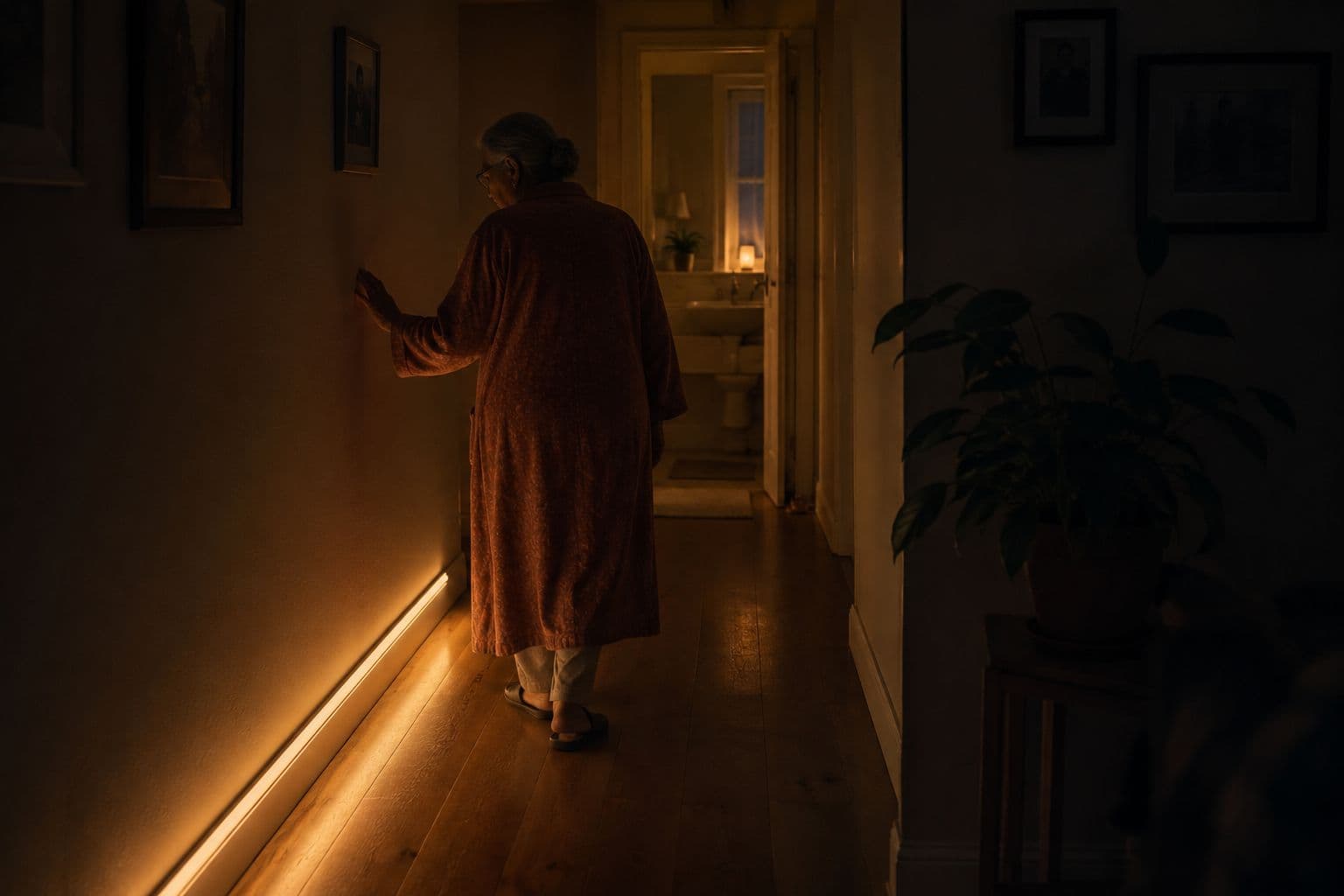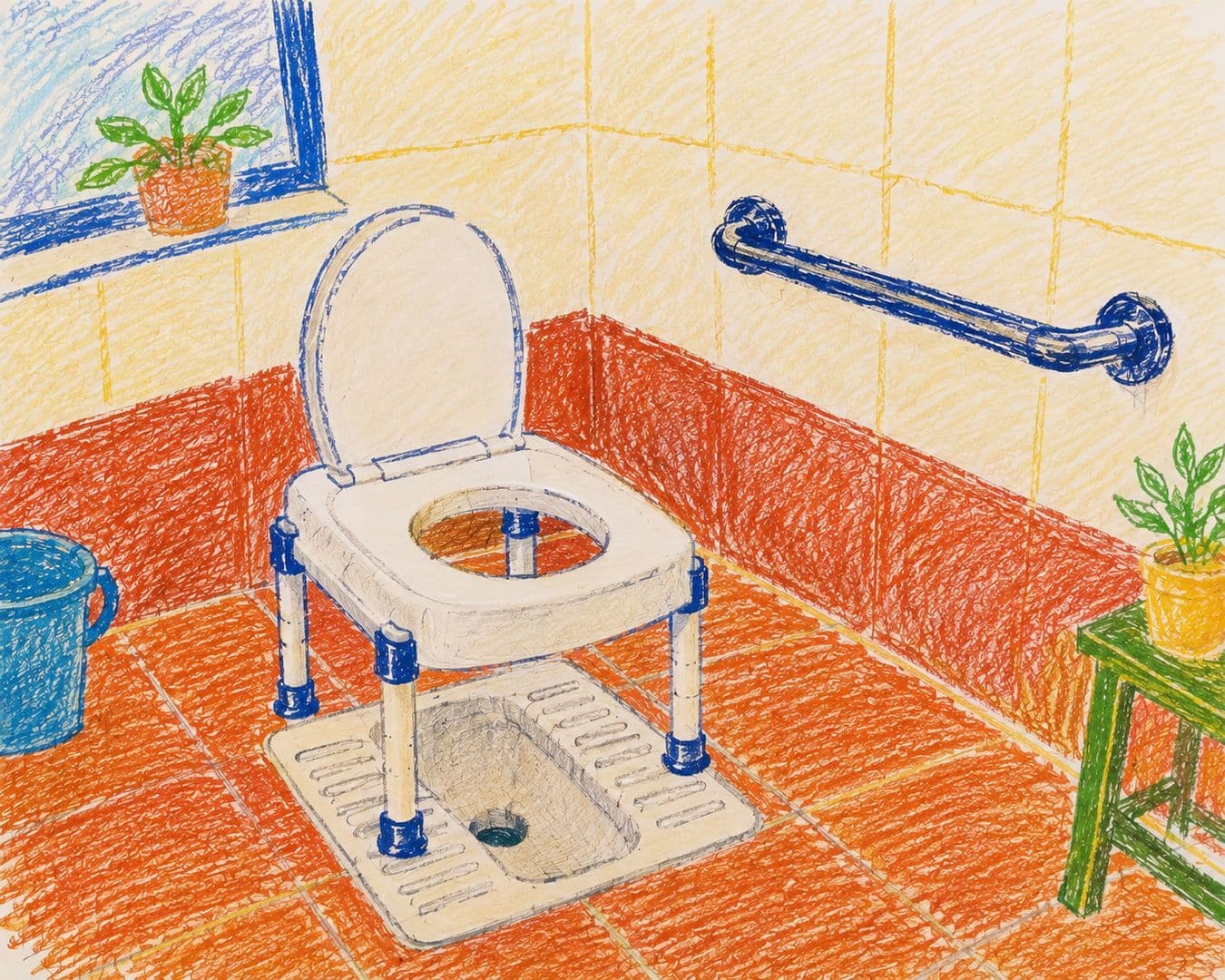
You check your phone first thing. No missed calls. Relief, for about four seconds. Then the same questions arrive anyway: did she take her medication? Did he make it to the appointment? What if something happened and no one called?
If that's a familiar loop, there's a real, defined term for what you're doing: long-distance caregiving — generally defined as caring for a parent who lives an hour or more away, though for a lot of families reading this, "an hour" is really "a flight, a visa, and a time zone." There's no single fix for the distance itself. But there's a genuinely useful set of home-based changes that, together, close most of the specific gap that makes this kind of caregiving so hard.
The research on why this specific kind of caregiving is so hard
It isn't in your head. Caregivers who live farthest from a parent report emotional distress at meaningfully higher rates — 47% — compared to those who live with the parent (43%) or nearby but not with them (28%). The reason isn't really about care tasks; distant caregivers often report less physical and financial strain than close-by caregivers. It's specifically the not-knowing that drives the distress: no way to notice a wobble, a skipped meal, a mood that's off, in the ordinary, ambient way you would if you lived down the street.
For NRI families specifically, research following India's ageing parents left behind by migrant children has found something worth sitting with: parents living apart from their children show measurably higher rates of functional disability and depression than parents living with family — and elderly parents are also, by pattern, the ones least likely to volunteer that anything is wrong. They don't want to worry you. So the information gap that causes your anxiety is often being actively, lovingly managed from the other end too.
The video-call setup: seeing, not just hearing
A daily call is genuinely valuable, and also genuinely limited: it tells you what your parent says, not what's actually happening. "We're fine, don't worry" is the single most common thing a distant parent says whether or not it's fully true. Voice alone strips out most of what you'd actually notice in person.
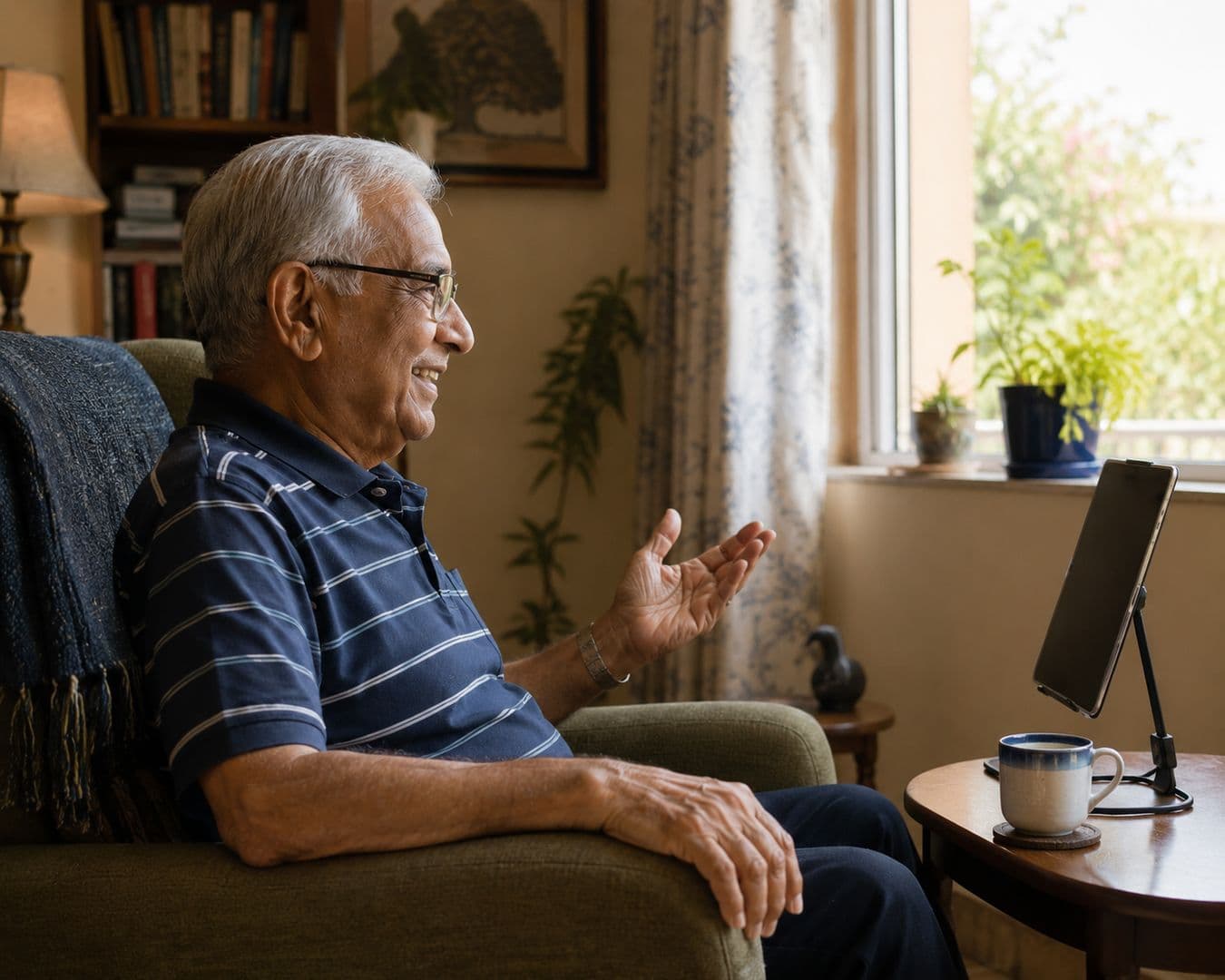
- A fixed, well-lit, comfortable spot they actually use for the call — not a phone propped against a fruit bowl.
- Eye-level, not phone-in-hand. A phone or tablet on a small stand, roughly at seated eye height, so you're actually looking at their face.
- Light on their face, not behind them. A window or lamp in front of them, not behind — backlighting is the single most common reason these calls look dim and hard to read.
- One dedicated, comfortable spot near a plug, so the call becomes something they walk to rather than something they scramble to set up — which also makes them more likely to initiate it themselves.
- Same time, most days. Consistency does more for reassurance than any single long call.
The entryway: what a visitor would notice, that you can't
If you can't be there, the next best thing is making sure the space itself is legible to whoever can — a neighbour, a helper, a delivery person, a relative who visits occasionally.
- Motion-sensor lighting at the entrance, so the approach and the door are genuinely visible at any hour, for your parent and for anyone checking on them.
- A clear sightline from the door to a chair, so your parent can sit while greeting a visitor or a delivery rather than standing precariously in a doorway.
- Uncluttered mail and package space just inside the door — a build-up here is one of the classic informal signs neighbours or helpers watch for, and it's worth keeping this spot easy to read at a glance.
The signal: a low-tech version of "checking in"
Long before smart-home sensors, communities used something simpler: a visible daily signal — a curtain opened each morning, a porch light switched off, a small flag — agreed informally with a trusted neighbour, that says "I'm fine" without requiring a conversation. It's a genuinely well-documented, reciprocal practice, and it's worth setting up deliberately if a neighbour relationship exists or can be built.
- One simple, consistent daily action — opening a specific curtain, turning off an entry light each morning — tied to a specific window or fixture a neighbour can actually see.
- A named, mutual arrangement, not an assumption. "If you don't see the curtain open by 9, please knock" is a real plan; a general sense that "someone would probably notice" is not.
- A smart plug on an existing lamp, if a formal neighbour arrangement isn't realistic — this gives you, remotely, the same signal a neighbour would otherwise be watching for, without adding a visible device or camera to the home.
The coordination point: one place everything lives
If a local helper, relative, or part-time carer is involved at all, a huge amount of long-distance anxiety comes from not knowing whether they have what they need.
- A single, visible spot for medication, instructions, and emergency contacts — a small wall-mounted board or a clearly labelled drawer near where care actually happens, not scattered across rooms or only in your parent's memory.
- A shared, simple written routine anyone stepping in could follow without a phone call to you first.
What this doesn't fix, and that's fine
None of this catches everything, and it isn't a substitute for the harder conversations about local support, whether that's a neighbour, a relative nearby, or professional help on the ground. But together, these pieces close the specific gap the research points to: not the tasks, the not-knowing. A well-lit face on a video call, a legible entryway, an honest signal, and one place where care information actually lives — that's a genuinely different experience of distance than a phone that might or might not ring.
If you're weighing bigger changes to a parent's home from a distance, Zuiora works with families to plan and prioritise remotely — you don't need to be in the room to get this right.
Sources
- myLifeSite, "The Challenge of Long-Distance Caregiving," citing National Alliance for Caregiving/AARP data
- Cimarolli, Horowitz & Pruchno, "Long-Distance Caregiving: Mental Health Consequences and Use of Resources"
- Providing Care From Afar: A Growing Yet Understudied Phenomenon in the Caregiving Field, PMC
- Samarth Elder Care, "The Diaspora Dilemma," citing India's Longitudinal Ageing Study (LASI), Harvard T.H. Chan School of Public Health & IIPS
- Happier at Home, "How to Help Aging Parents From Afar"
- Graying With Grace, "The Neighbor Check-In System That Could Reduce Your Family's Daily 'Are You Okay?' Calls"
- 7 Day Home Care, "4 Ways Elderly Neighbors Can Keep Tabs on Each Other Daily"