Your mother mentions, almost in passing, that she's up two or three times a night now. Not sick, not in pain — just up. You file it away as an aging thing, mildly annoying, nothing urgent. It's worth filing somewhere else instead: this single detail is one of the strongest predictors of a fall you'll get, and it's worth treating as a real project rather than a passing comment.
The pattern researchers keep finding
About half of adults over 65 get up at least once a night to use the bathroom, and roughly a quarter get up two or more times. On its own, that's just biology. The problem is what it does to fall risk: close to a quarter of all falls among older adults happen overnight, and about a quarter of those are directly tied to this exact walk — bed to bathroom, in the dark, often still half-asleep. Adults who make two or more of these trips a night have more than double the risk of a fracture or fall-related injury compared to those who don't.
The mechanism is almost embarrassingly simple: someone half-asleep gets up in a dark or dimly lit room, and their body — not yet fully awake, not yet steady — has to navigate furniture, doorframes, and flooring it can't clearly see. It's not a coordination problem or a confusion problem. It's an environment problem happening at exactly the moment a person is least equipped to compensate for it. Which means the environment is exactly where the fix belongs — and it's rarely just one fix. A full nighttime-safe route touches lighting, flooring, furniture, and the bathroom itself, each addressing a different part of the same ten-foot stretch.
Lighting: the foundation, done properly
"Add more lighting" is the standard advice, and it's not wrong — it's just incomplete on its own. A bright overhead light solves the dark part and creates a new problem: it's genuinely disorienting to go from pitch black to full brightness at 3am, and the glare itself can trigger a stumble as much as the darkness did. The goal isn't more light, it's the right kind, in the right place, active only when it's needed.
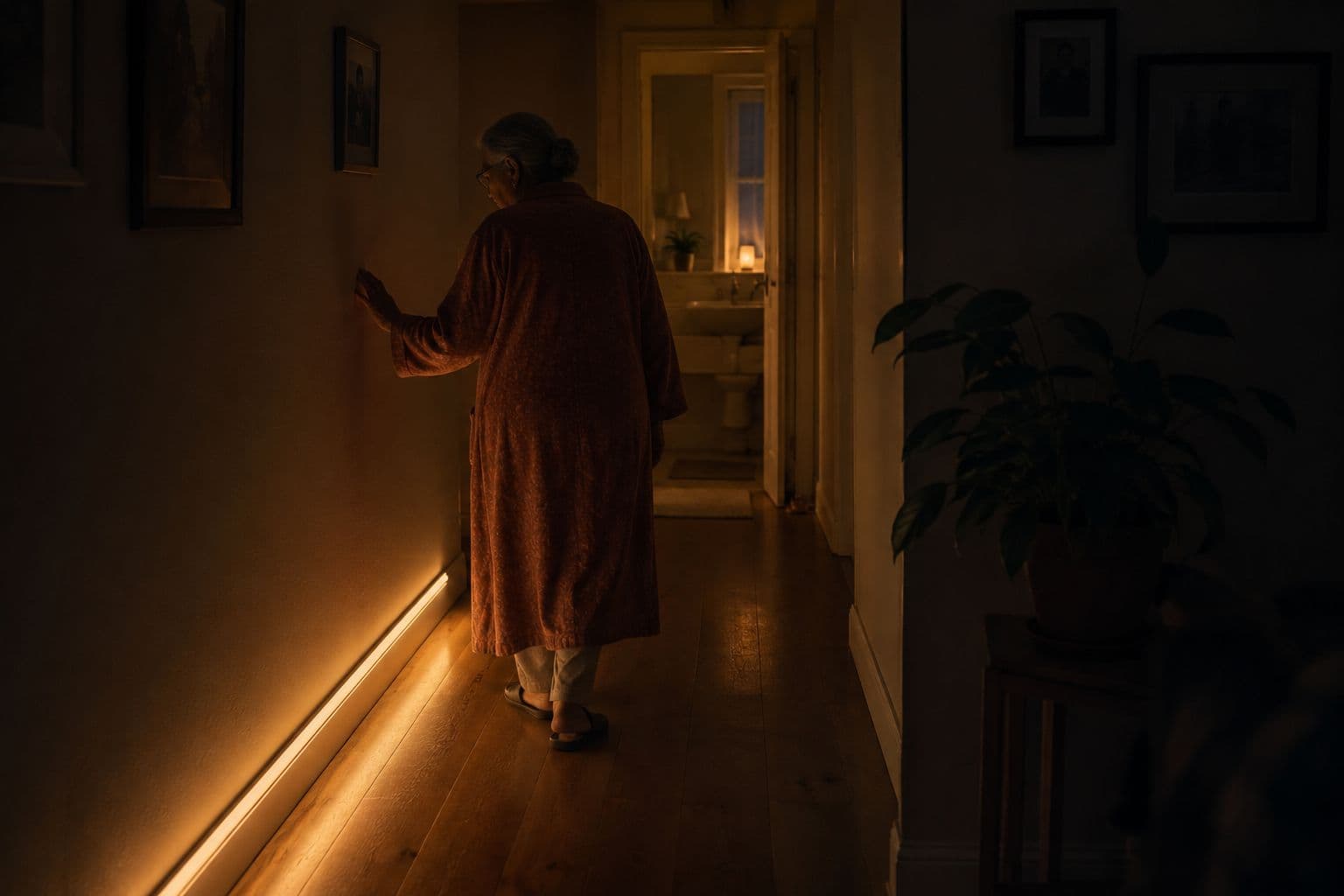
- A continuous motion-triggered path light, bed to bathroom — low-level, warm-toned, floor- or baseboard-height rather than overhead. Think closer to moonlight than daylight: enough to see the floor clearly, dim enough not to fully wake the nervous system or make it harder to fall back asleep.
- Motion-triggered, not switch-triggered. A groggy hand at 3am won't reliably find a switch; movement should be all it takes.
- A separate, similarly low bathroom light — not the main overhead fixture, which is often the brightest light in the house and the worst possible thing to face half-asleep.
- The full route, not just the bathroom. The bedroom-to-bathroom stretch is where the fall actually happens; lighting the bathroom alone misses most of the risk.
Flooring and the path itself
Light exposes a hazard; it doesn't remove one. A perfectly lit route with a loose rug or trailing cable in it still fails.
- Remove or firmly secure any rug along the route. If a rug matters to the room's feel, a low-pile, non-slip-backed one is a reasonable compromise; a thick or loose one is not.
- Flat, matte flooring finishes over high-gloss ones. Glossy floors catch and scatter light in a way that can be genuinely disorienting under low, angled night lighting.
- A flush, threshold-free transition between bedroom and hallway, and hallway and bathroom, where possible. Raised thresholds are an easy, unremarkable trip point precisely because they're rarely thought of as a hazard.
- Keep the walking width genuinely clear — a chair, a laundry basket, an open door left ajar can all narrow a route that was designed to be wide enough.
Furniture: making the transitions themselves safer
Two moments carry most of the actual risk — getting out of bed, and sitting down or standing up in the bathroom.
- Bed height matched to the person, so feet reach the floor without a drop or a climb. A too-high bed makes the first step down unstable; a too-low one makes standing up harder and slower, which matters when balance is already compromised by sleep.
- A grab bar or sturdy rail near the bed, mounted to the wall rather than relying on furniture, for anyone who needs a moment of support standing up.
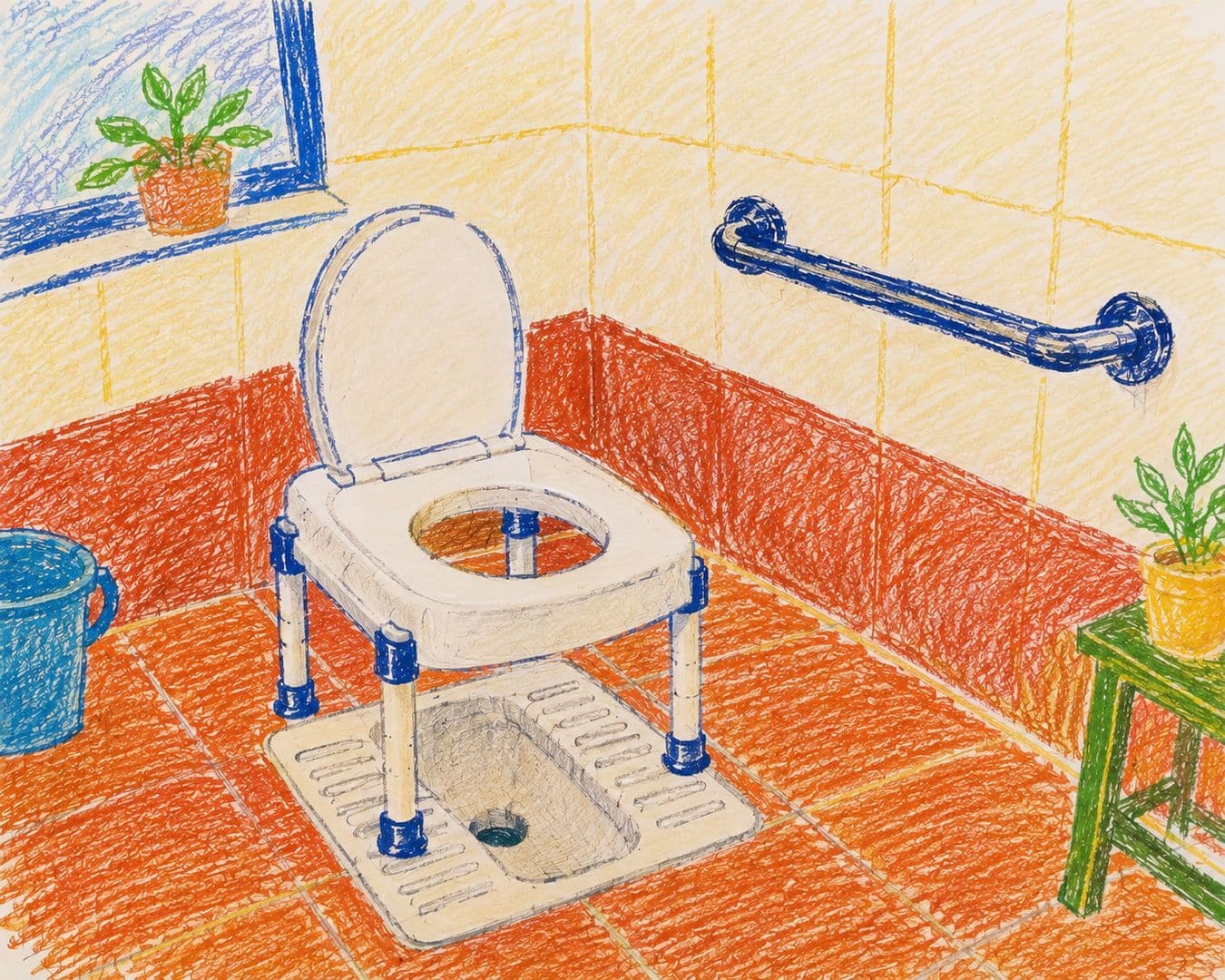
- A raised toilet seat or comfort-height toilet, if getting up from a low seat has become effortful — this reduces the number of unsupported, off-balance seconds in the bathroom itself.
- For higher-risk situations, a bedside commode — not as a permanent fixture, but as an option that removes the walk itself for a period when falls are a live concern (recovery from illness or surgery, for instance).
The layout question worth actually asking
For a household where the bathroom is genuinely far from the bedroom — a different floor, the far end of a long hallway — the honest, if bigger, question is whether the distance itself is the real problem no amount of lighting fully solves. This isn't the first thing to try, but for a parent with declining mobility, relocating the primary bedroom closer to a bathroom, or adding a half-bath nearer the bedroom, is sometimes the single highest-impact change available — worth a real conversation, even if it isn't acted on immediately.
What this doesn't require
No renovation, no medical device, no conversation about "getting old" to start with. A plug-in or battery motion-sensor light strip along a hallway costs very little and installs in minutes — that's the reasonable first move for almost every household. The larger pieces — bed height, grab bars, flooring, layout — are worth doing over time, in whatever order the specific home's actual risks suggest, rather than all at once.
If your family is weighing bathroom layout, flooring, or a broader lighting plan, Zuiora can help you sequence what actually matters most first.
Sources
- CDC, "Facts About Falls"
- Nocturia, StatPearls, National Library of Medicine
- Cimarolli et al., "The Association of Nocturia with Incident Falls in an Elderly Community-Dwelling Cohort," Journal of the American Geriatrics Society
- University Pharmacist, "Nocturia in Older Adults: Highlighting Nocturnal Polyuria"