If you've searched "community service ideas for teens" recently, you've seen the usual lineup: soup kitchens, animal shelters, park cleanups, tutoring programs. All legitimate. All also requiring a ride, a sign-up sheet, a set schedule, and often a parent to coordinate it.
Here's one that's quietly already on some of the bigger, more established lists, usually buried as a single bullet point: helping an elderly family member make their home safer. No commute, no application, no stranger to be paired with. Just someone you probably already see regularly, and a real, documented afternoon of work.
Why this one actually counts
Most community service programs care about two things: real time spent, and real impact. This clears both. A grab bar installed, a hallway relit, a walking path cleared of trip hazards — these are concrete, photographable, before-and-after changes, not vague "I helped out" hours. If your school or program wants a reflection paragraph with your log, you'll actually have something specific to write, instead of padding out a shift you barely remember.
It also solves the actual annoying part of most service ideas: logistics. You don't need someone to vet you, schedule you, or supervise you. You need an afternoon and a family member's address you probably already have memorized.
Pair it with the other real assignment: the grandparent interview
If your school has ever assigned a family-history or oral-history project — interview a grandparent about their childhood, their first job, what school was like for them — you already know this is a common, real assignment, not a niche one. It turns out the same visit works for both things at once.
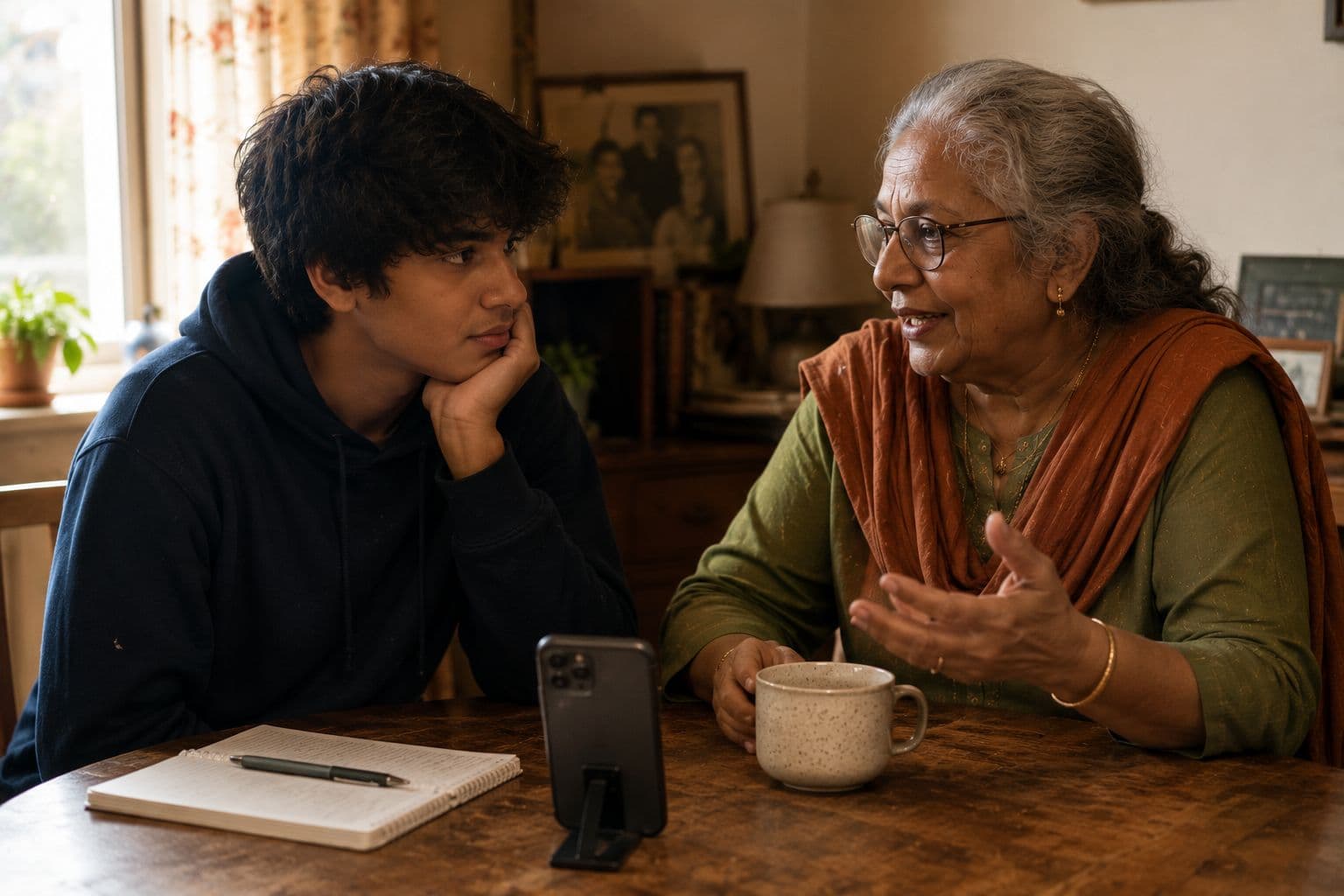
Spend the first half doing the interview: record it on your phone, ask about where they grew up, what their house looked like, what they wanted to be when they were your age. Spend the second half actually looking at the house you're sitting in. You'll probably notice things you wouldn't have if you'd just dropped by for twenty minutes — the hallway that's dim by the time you're wrapping up, the step they mention almost in passing, the stool by the kitchen shelf.
Two real deliverables, one visit: a recorded interview, and a documented set of home improvements.
What to actually do (and log)
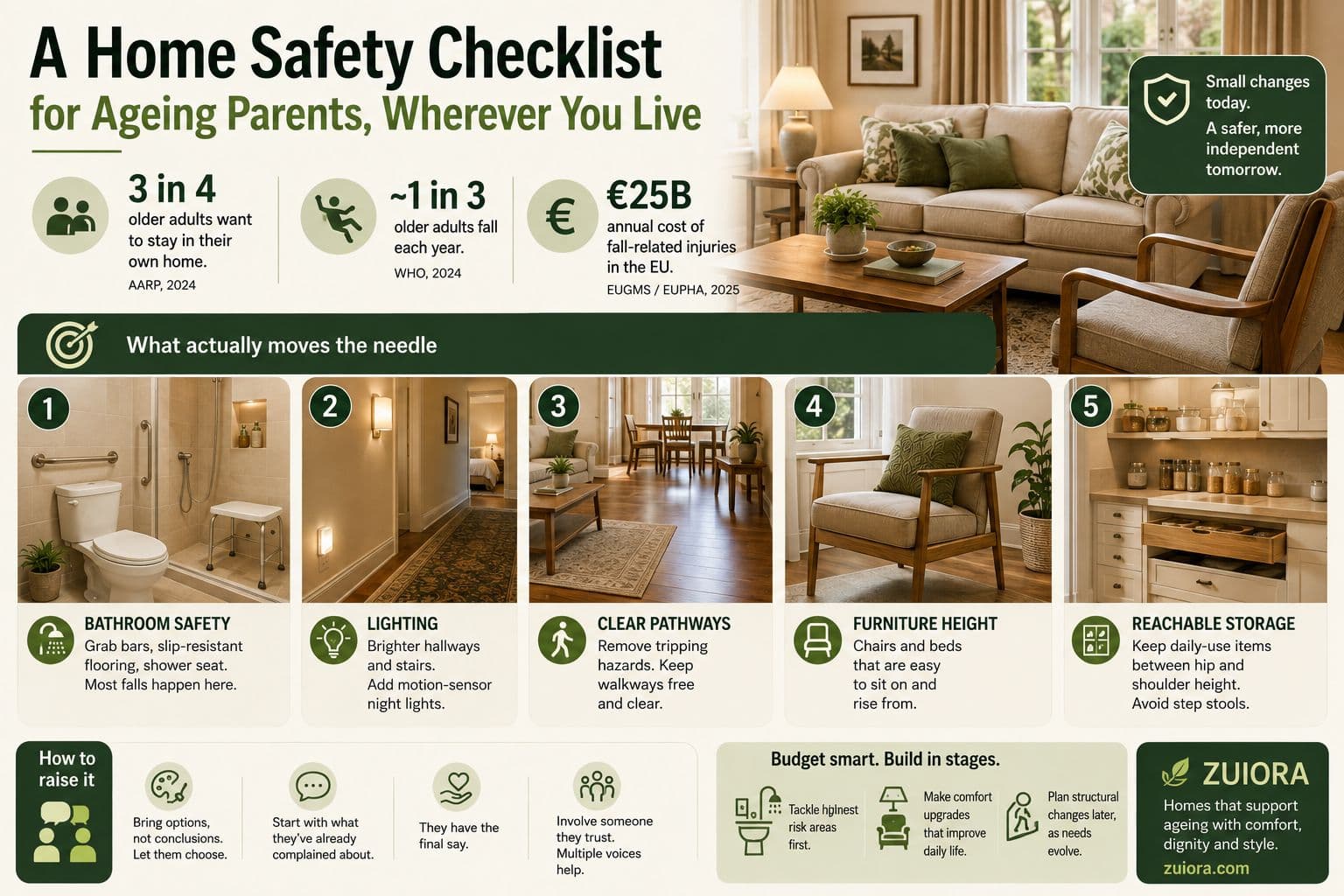
- Fix the lighting. Swap a dim bulb for a brighter one, or add a cheap motion-sensor night light near the bathroom. Photograph before and after — this is exactly the kind of concrete change a service log wants.
- Clear the walking path. Loose rugs, trailing cables, anything in the route between bedroom and bathroom or kitchen and living room. Note the time spent; it counts.
- Move daily-use items within reach. If they're climbing on a stool for something they use every day, move it down. Small, specific, loggable.
- Add a grab bar or non-slip mat, if you're able to install it safely — otherwise, this is a good one to note as a "next visit" item with a parent or contractor, which is still worth logging as identified and planned.
- Write your reflection while it's fresh. What you noticed, what you changed, what you'd do next visit. This is usually the part students skip and the part programs actually read.
Before you start: ask, don't assume
The visit works best if you ask what actually bothers them about their own home, rather than deciding for them.
Try: "Is there anything here that's annoying to use?"
You'll get a specific, real answer — and it'll usually be more useful than anything on this list.
If you're not in the US
"Community service hours" as a formal requirement is largely an American thing, tied to high school graduation rules and college applications — so if that's not how things work where you are, the idea still holds, it's just filed differently:
- In the UK and much of the EU, the closest equivalent is the Duke of Edinburgh's Award (usually just called "the DofE"), which has a Volunteering section built into every level. A recognised activity spent improving an elderly relative's home safety fits comfortably within it, and international schools running the IB Diploma can often count the same hours toward their CAS (Creativity, Activity, Service) requirement at the same time.
- In India, the same programme runs under the name International Award for Young People (IAYP), active since 1962 and structured the same way — Service (sometimes called Voluntary Service) is one of its four mandatory sections. Many Indian schools also run their own social-service or NSS-linked hours where a documented visit like this would count.
Whatever the framework, the documentation habit is the same: photos, a time log, and a short reflection.
FAQ
Does this actually count for community service hours? Check your specific program's rules — most accept "helping a family member with home safety/accessibility improvements" as a valid category, and some list it explicitly. When in doubt, ask your coordinator or Award Leader before logging it, and keep photos and a time log either way.
What if they don't want anything changed? Don't push it. Ask what they'd be open to, and let something as small as one better light bulb count. The interview half of the visit still stands on its own.
Do I need to buy anything? No — most of the highest-impact fixes (lighting swaps, decluttering, moving items within reach) use things already in the house or cost very little.
Zuiora designs homes that work for every generation in and around them. zuiora.com
Sources
- PrepScholar, "423 Amazing Community Service Ideas"
- Greenlight, "25+ Volunteer & Community Service Ideas for Teens"
- FamilySearch, "Good Questions to Ask Your Grandparents"
- TulsaKids, on recorded interviews for family-history school projects
- The Duke of Edinburgh's International Award Foundation
- International Award for Young People, India